
Corinth had not been making idle threats. The remainder of 433 saw no more fighting, but they were now openly hostile towards Athens, though not yet formally at war. Corinth’s insinuation that Athen’s empire was ready to rebel against her had some truth to it. It was this fear of rebellion, and the fear of losing their hegemony at sea that had compelled the Athenian Assembly to ally with Corcyra. Athens suspected one polis in particular: Potidaea.
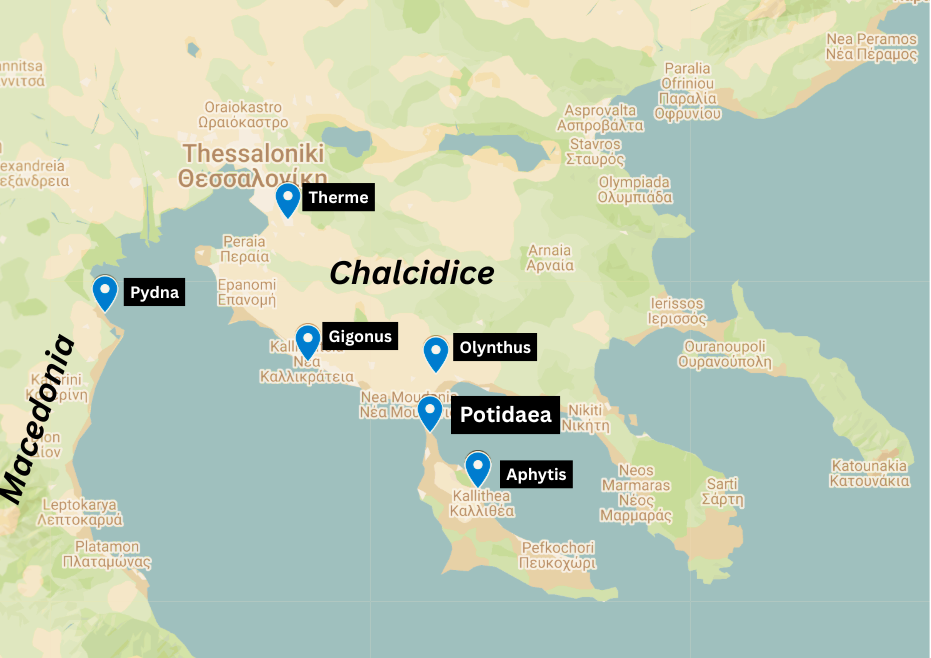
The city of Potidaea occupies the isthmus of the Pallene peninsula, which is part of the larger Chalcidian peninsula between Thrace and Macedon, roughly one hundred and fifty miles north of Athens. The city was an Athenian ally, but it was a colony of Corinth, and the Potidaeans retained a close relationship with their mother city. If they were to rebel, unrest would certainly spread to other Athenian tributaries in the area.
Corinth’s influence was not the only concern in the region: the Macedonian king Perdiccas, son of Alexander, had been threatening Athenian control throughout Thrace and Chalcidice before the battle at Sybota. Perdiccas had been a reliable friend to the Athenians until recently. He was locked in a struggle against his brother Philip, who was being supported by Derdas, the king of Elimiotis, a small kingdom in the southwest of Macedonia. The Athenian Assembly had voted for an alliance with Philip, and in response Perdiccas had dispatched envoys to Corinth and Sparta to incite them against Athens. The Athenians knew that Perdiccas’ agents were working throughout the Chalcidian peninsula and Thrace, building relationships and encouraging Athen’s subject-cities to ready for rebellion.
Athens was not going to take a wait-and-see approach with Potidaea. Ambassadors were sent to the city to counter Corinth’s influence and Perdiccas’ provocateurs. The Athenians ordered that the wall on the southern side of the city which faced the Pallene be torn down. Then they ordered the Potidaeans to expel their magistrates, who were Corinthian appointees. If this was not enough, they took hostages as an insurance policy: if the Potidaeans were to rebel, the hostages would be killed. This was a common practice for the ancient world, but just because it was common did not make it easier to bear.
Over the winter Potidaea sent representatives to Athens to beg the Athenian assembly not to take further measures against them. Representatives were also sent to Corinth and Sparta in case Athens refused. If the Potidaeans had not been considering rebellion before, they were now.
It is during this winter between 433 and 432 that Athens issued the Megarian Decree. Megara was an ally of Corinth and Athen’s immediate neighbor. It had been Megarian triremes that had been the first to rout at the battle of Sybota. The decree banned Megarian ships from making port anywhere within Athen’s empire, and Megarian merchants were expelled from the agora in Athens. The justifications were that Megara had violated sacred Athenian land and Megarian farmers were encroaching on Attican soil; and runaway Athenian slaves were being sheltered by Megara. It is our first historical record of an embargo by one state against another during peacetime, and it was obviously meant to punish Megara and dissuade Corinth’s allies from joining her.
Athens had their eyes on Corinth to the south and Macedonia to the north. There was still hope that a larger war could be avoided, Pericles was personal friends with the Spartan king Archidamus, and the Megarian decree would not seriously impact Megara’s economy, but it would send a message. The message that Pericles and Athens had been attempting to send was one of restraint. If they had wanted to crush the Corinthian fleet and cripple them, they would have.
Perdiccas was actively making trouble, and Athens dispatched thirty ships with a thousand hoplites to reinforce Philip in Macedonia. The Potidaean envoys had spent months begging the Athenians, but they had been unable to secure any guarantees from Athens, and now ships were being sent north. If Athen’s ships reached Potidaea, what was to prevent the city from suffering further injury? Thucydides tells us that their fears were well founded, the commander of the Athenians had orders to tear down the northern wall of Potidaea and to take more hostages. A Spartan ephor had secretly promised that they would invade Attica if Potidaea was attacked: It was now or never. As the winter ended Potidaea expelled the Athenians from the city. Potidaea was in open revolt.
The news spread as fast as it could travel. When word reached Corinth the city went into a frenzy: Athens was unlikely to use a light hand against the rebellious Potidaeans, and the Corinthians feared for their colonial cousins. Though Corinth was hostile against Athens, they were not yet in open war. Aristeus, the son of Adimantus, volunteered to lead a company to reinforce his Potidaean friends. Aristeus was very popular in Corinth, and many of the men who volunteered did so primarily because of their concern for his safety more than out of any love for Potidaea. The number of their company was supplemented by mercenaries. Sixteen hundred hoplites and four hundred light troops set out from Corinth. It would be a hard march overland, through mountainous terrain past Attica, through Thessaly, and then through Macedonia before they could reach Chalcidice. They could not risk going by sea.
In Athens, the news of Potidaea’s revolt was quickly followed by word of Aristeus’ march. They immediately sent out forty ships and two thousand hoplites, commanded by Callias son of Calliades, with orders to bring Potidaea back into line.
The force sailed north along the coasts of Euboea and Thessaly, then of Macedonia, where they discovered the thirty ships that had set out over the winter camped outside the walls of Pydna alongside Philip’s Macedonians, and laying siege to the city. Their commander Archestratus had sailed to Potidaea to take more hostages, but when he arrived he had found the entire region was already in revolt. Perdiccas’ ambassadors had convinced the Chalcidians along the coast to abandon their towns and cities and make for Olynthus, seven miles northeast of Potidaea, and in-land. Those that went to Olynthus set to work fortifying the city. For the rest of the Chalcidians Perdiccas had given them land in the north, far from the coast and the Athenian fleet. Most of the Chalcidian peninsula had revolted alongside Potidaea.
Archestratus recognized that he and his one-thousand hoplites were not enough for a revolt of this size. They sailed northwest and took the city of Therme, thirty miles northwest of Potidaea, before making for Macedonia, where they had joined the forces of Philip outside the walls of Pydna, Perdiccas’ capital. Callias and his two thousand hoplites joined the siege. Meanwhile, Aristeus and his volunteers had marched up through the interior and around the Athenians to reach Potidaea. It had taken them forty days, and they set to work fortifying the city.
The news of Aristeus’ arrival reached Callias and the troops outside Pydna. They opened negotiations with Perdiccas and came to terms: Perdiccas would join Athens as an ally. Thucydides does not tell us what Philip thought of this, but the Athenian and Macedonian force marched north to Beroa. They made their way into Chalcidice and tried to take the city of Strepsa but had been repelled. At some point during the march Perdiccas and two hundred horsemen defected and rushed south where they linked up with Aristeus and the volunteers from Corinth. After failing to take Strepsa, the Athenians and Philip’s cavalry marched to Gigonus and made camp sixteen miles away from Potidaea.
Both sides prepared for battle. Callias would lead the main force of Athenian hoplites along the coast, on their right, they would be shadowed by seventy triremes. 600 Macedonian cavalrymen and the allied infantry would break off and move towards Olynthus to prevent any aid from reaching Potidaea. Outside the city, Aristeus had been chosen to lead the allied infantry, while Perdiccas was given command of the cavalry and the defense of Olynthus. Aristeus’ plan was to meet the Athenians in the field, and Perdiccas and the Chalcidians inside Olynthus would threaten the Athenian rear.
The Athenians broke camp and marched south. After a few hours they came within sight of the city, and both armies began lining up for battle. It would be an honorable fight, phalanx to phalanx, outside the walls of Potidaea, where the isthmus narrows to half a mile wide. In front of the lines of hoplites sacrifices were made. The Athenians advanced, chanting their paean as they marched toward the Corinthians, who chanted their own war-song. The lines neared, and the two phalanxes set to work against each other.
Across the line men pushed forward. Phalanx battles were exercises in endurance; some battles could take hours. In some places there was a small gap of a yard or two, in some they were shield to shield, the men in the back ranks pushed the men at the front into the enemy. The troops at Olynthus saw the signal go up, and Perdiccas and the Chalcidians began marching out to reinforce Aristeus. On his wing, Aristeus was winning, his Corinthian volunteers and picked troops were pushing back the Athenians. The fighting was fierce across the line. Callias was killed. A young Athenian, about 18 or 19, by the name of Alcibiades was wounded and on the ground when an older hoplite picked him up and pulled him away from the Corinthian spears.
In front of Aristeus the Athenians began pulling back, then they started to run, and the Corinthians followed. That part of the Athenian line had completely collapsed, and the Corinthians chased after them until they were far away from the battlefield. But it had not been a full collapse, the rest of the Athenian line held, and the Potidaeans were still locked against them shield-to-shield.
The troops outside Olynthus were forming up. Philips’ 600 Macedonian cavalry had intercepted the Chalcidians on their way to the battlefield. From their viewpoint both sides could see the battle and the breaking Athenians; neither force advanced.
Aristeus and his Corinthians had killed many Athenians, and Aristeus was far away from the fight when he finally looked back. Where the Corinthians had left the line to give chase the Athenians had swung around the Potidaean flank, and now they were retreating back into the city. Perdiccas and the men from Chalcidice saw this as well. Seeing that the battle was already lost they pulled back inside Olynthus and the Macedonian cavalry started toward Potidaea.
Aristeus and his Corinthians were now completely exposed. They could see the dust in the air from the Macedonian cavalry that was heading their way, they would not be able to make a run for Olynthus. In front of the city the Athenians were beginning to notice this small group of Corinthians that was now behind them. Aristeus gathered the men close together. They had to make a decision quickly if they were to avoid death or capture. They made a tight formation with their shields and made a run for it along the edge of the beach towards the city. The Athenians saw what was happening and hurled javelins and spears at the Corinthians. The Corinthians sprinted through this hail of missiles with their shields held up until they reached the breakwater close to the wall: Aristeus, and most of his men, had made it back to city.
The Athenians looked to their wounded and stripped the enemy dead. A truce was declared so the Potidaeans and Corinthians could collect their dead and observe the burial rights. The Athenians had lost their general, and one-hundred-and fifty men. The Potidaeans and Corinthians lost close to 300.
The Athenians began constructing siege works outside the city. They were still threatened from behind by the troops at Olynthus, and the commanders of the Athenian army were not confident that they could divide their force and besiege the southern wall on the other end of the isthmus.
Alcibiades recommended his rescuer for an accommodation for bravery: it was his messmate and budding friend Socrates. The hoplite was about 37 years old, and he had earned a reputation as one of the toughest soldiers in the army. Socrates rejected the accommodation, instead he recommended Alcibiades, who was recognized for his bravery amongst all the Athenians outside the walls of Potidaea.
Aristeus and the Potidaeans were not idle. They had rebuilt the southern wall and were preparing for a siege. When the news reached Athens that only the north side of Potidaea was under siege, they sent another force of 1600 hoplites led by Phormio, son of Asopius. They landed at Aphytis, about nine miles south of Potidaea. On their way to the city Phormio and his Athenians raided the countryside, burning and ravaging as they went. The northern and southern sides of the city were now cut off, and the Athenian navy had blockaded both sides that faced the sea. It was only a matter of time.
Their only hope now laid in aid from Corinth, which was unlikely. The troops at Olynthus could harass the Athenian rear but could not meet them in open battle. Aristeus devised a plan – he and 500 men would remain in the city and tie down Athenian forces. The rest of the men would run the blockade and make for Chalcidice and continue the fight there. With their numbers reduced they would be able to prolong the siege with careful rationing. Most of the Corinthians there had only volunteered because of Aristeus, they would not abandon him; either they all ran the blockade, or no one would. Aristeus accepted this ultimatum. They waited for a favorable wind, and under the cover of night the Corinthians and Potidaeans slipped their way past the Athenian triremes.


Leave a Reply